
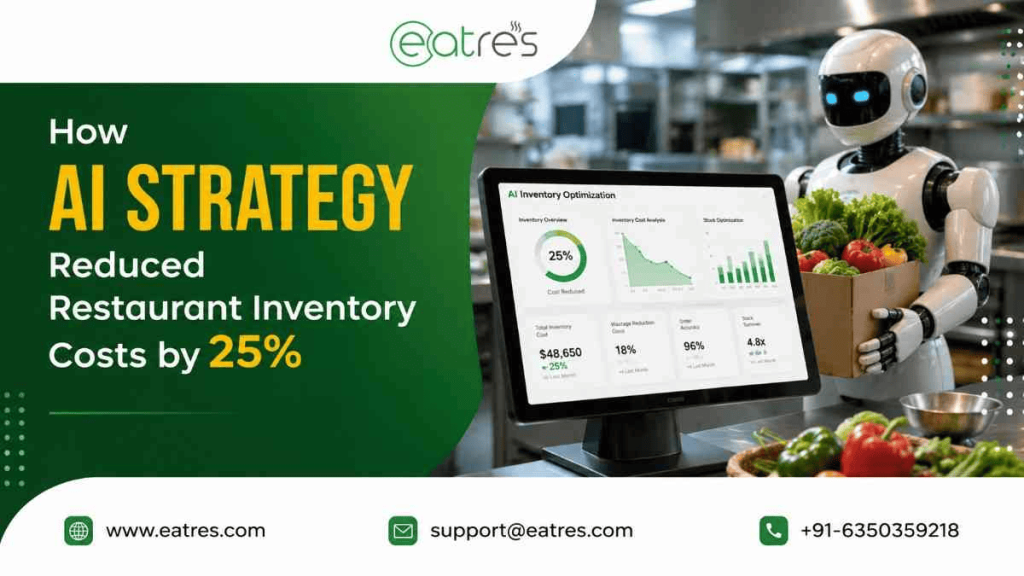
Imagine throwing away thousands of dollars every month not because your restaurant lacks customers, but because your inventory management is inefficient. Let’s explore how did AI reduced restaurant inventory costs by 25% and why it’s becoming the future of restaurant operations.
Food waste, overstocking, and inaccurate demand forecasting silently eat into restaurant profits every single day. According to the UN Environment Programme (UNEP), nearly 19% of food available to consumers globally is wasted, while the FAO estimates roughly one-third of all food produced worldwide is lost or wasted across the supply chain. For restaurants, this translates into unnecessary purchasing costs, spoiled ingredients, and shrinking profit margins.
The solution? Artificial Intelligence (AI).
Restaurants worldwide are leveraging AI-powered inventory management to predict demand, reduce food waste, automate stock replenishment, and ultimately lower inventory costs by as much as 25%.
Why Is Inventory Management One of the Biggest Challenges for Restaurants?
Inventory isn’t just about keeping shelves stocked. Restaurant managers must balance:
- Preventing food spoilage
- Avoiding stock shortages
- Managing seasonal demand
- Controlling purchasing costs
- Maintaining consistent menu availability
Even small forecasting mistakes can create major financial losses.
Inventory Challenges by the Numbers
| Challenge | Industry Statistics |
|---|---|
| Food waste | Up to 10% of purchased food is wasted before reaching customers in many food-service operations. |
| Inventory carrying costs | Typically account for 20-30% of inventory value annually. |
| Food costs | Usually represent 28-35% of total restaurant revenue. |
| Manual inventory errors | Can increase inventory variance by 15-20% in busy operations. |
When margins are already thin, every percentage point matters.
How Does AI Reduce Restaurant Inventory Costs by 25%?
Traditional inventory systems rely heavily on historical sales and manual counting.
AI takes a completely different approach. Instead of simply tracking inventory, AI continuously analyzes:
- Daily sales trends
- Customer purchasing behavior
- Weather forecasts
- Local events
- Seasonal demand
- Delivery schedules
- Ingredient shelf life
Using machine learning algorithms, the system predicts future demand with remarkable accuracy.
For example:
Instead of ordering 100 kilograms of tomatoes every week, AI may recommend purchasing 74 kilograms because rainy weather is expected to reduce customer traffic.
The result?
Less waste.
Lower purchasing costs.
Higher profits.
Which AI Features Deliver the Biggest Cost Savings?
Modern AI inventory platforms combine several intelligent features.
Predictive Demand Forecasting
- AI forecasts exactly how much inventory will be needed based on real-time sales patterns.
Benefit: Prevents over-ordering and stock shortages.
Automated Reordering
- The system automatically generates purchase orders when stock reaches optimal levels.
Benefit: Eliminates emergency purchasing and reduces excess inventory.
Food Waste Monitoring
- AI identifies ingredients approaching expiration and suggests promotions or menu adjustments before spoilage occurs.
Benefit: Significantly lowers food waste.
Real-Time Inventory Tracking
- Connected POS systems update inventory after every order.
Benefit: Managers always know current stock levels.
Supplier Optimization
- Some AI platforms compare supplier pricing and delivery performance.
Benefit: Reduces procurement costs while improving supply reliability.
What Results Are Restaurants Seeing After Adopting AI?
Restaurants implementing AI inventory systems commonly report measurable improvements.
Average Performance Improvements
| Metric | Before AI | After AI | |||
|---|---|---|---|---|---|
| Inventory Costs | 100% | 75% | |||
| Food Waste | High | 20-40% Lower | |||
| Stockouts | Frequent | Up to 50% Fewer | |||
| Inventory Counting Time | Several hours weekly | Reduced by up to 80% | |||
| Forecast Accuracy | Around 60-70% | 80-95% |
These improvements directly impact profitability while enhancing operational efficiency.
Can Small Restaurants Benefit from AI Too?
Absolutely. AI inventory software is no longer limited to large restaurant chains. Affordable cloud-based solutions now make advanced inventory management accessible to:
- Independent restaurants
- Cafés
- Cloud kitchens
- Food trucks
- Bakeries
- Quick-service restaurants
Many platforms integrate seamlessly with existing POS systems and require minimal technical expertise.
What Should Restaurants Consider Before Implementing AI?
While AI offers impressive benefits, success depends on proper implementation. Restaurant owners should focus on:
- Accurate initial inventory setup
- Clean historical sales data
- Staff training
- POS integration
- Regular performance reviews
AI performs best when paired with consistent operational practices.
Is AI Inventory Management the Future of Restaurants?
The restaurant industry is becoming increasingly data-driven. With rising food prices, labor shortages, and tighter profit margins, AI enables restaurants to make faster, smarter, and more profitable inventory decisions.
Businesses that embrace AI today are better positioned to reduce waste, optimize purchasing, improve customer satisfaction, and stay competitive in an evolving market. The question is no longer whether restaurants should adopt AI- it’s how soon they can begin.
Final Thoughts: Are You Ready to Reduce Inventory Costs by 25%?
Artificial Intelligence is transforming restaurant inventory management from a reactive process into a proactive, data-driven strategy. By predicting demand, reducing food waste, and automating stock decisions, restaurants can significantly cut costs while improving operational efficiency.
Whether you run a single café or a multi-location restaurant chain, investing in AI-powered inventory management could be one of the smartest business decisions you make.
Ready to Transform Your Restaurant Operations?
Want to discover how AI can streamline your inventory, reduce food waste, and maximize profits? Contact us today for a personalized AI inventory consultation and see how did AI reduced restaurant inventory costs by 25% while serving customers more efficiently.